
research-kit by example: choosing a local LLM
A walk through research-kit's research plugin on one small project, from setup to findings, a library and a commit, with the dashboard at each step.
research-kit is a kit for doing research with a coding agent, and its research plugin is the part every project uses.
This page walks through that plugin on one small project, from an empty folder to the first findings, showing at each step what to say to the agent and what the kit does in response.
The first post tells where the kit came from; this one is about using it.
When the research plugin is useful
The plugin is built for one person doing research with one coding agent, over many sessions. A coding agent starts every session cold, so whatever the research has established has to live somewhere the next session reads and trusts. The plugin keeps it in the repository, as Markdown files the agent writes through a command-line tool and a check that runs on every commit.
It fits a project that needs some of the following:
- A record of the research itself. Ideas, questions, tasks and findings are one file each, and each moves from one state to the next only through the tool, which writes everything the new state needs. A question says what would answer it before any work starts, and a finding names the evidence it rests on.
- A task tracker shaped like a card game. Ideas, questions and tasks are cards. A card lies in a deck until it is drawn into a hand, the few cards its owner is working on now; the agent and the person each have one, and a ranked list decides what is drawn next.
- A visual overview. A read-only dashboard on localhost lays the records out as a table of cards, each card’s value shown by its frame, so the state of the project is visible at a glance.
- Checks that stay fresh. A finding’s evidence is something the check can resolve: a script of the project’s own that asserts its result and can be re-run, a work in the library, or a proved declaration. The commit fails when a record does not hold together, a link points nowhere or a cited work has no card.
- A reference library. One card per cited work, recording how far it was actually read and the extracts a claim may rest on, so a citation never stands on a summary.
- Goals and directions. The person can set a destination and say where their interest leans, and the ranking of the next work leans the same way without being bound by it.
A project with a Lean 4 library adds the formal plugin, which checks the prompt a prover session receives before it is sent and checks what the session reports against the built library before any document changes.
That plugin is out of scope here.
The example project asks a practical question: which open-weight LLM, served by which runtime, runs best on an old laptop with no discrete GPU. The screenshots are the plugin’s dashboard at each step, and the records in them are the ones the project produced.
Installing the plugin
In Claude Code, the simplest way to start is to install the plugin from the shell, in the project’s folder, before the agent starts, so that its skills are loaded from the first session:
mkdir best-local-llm-research && cd best-local-llm-research
claude plugin marketplace add 'lividgreen/research-kit#latest' --scope project
claude plugin install research@research-kit --scope project
claude
The first command adds the kit’s marketplace at latest, the branch each release moves to its tag, and the second installs the plugin for this project only.
Both are written into .claude/settings.json, so a collaborator who clones the project finds them named there.
The installation guide covers Codex, GitHub Copilot, Cursor and the other agents.
Setting up the project
The setup is a skill of its own:
/research:research-initThe agent probes the folder and the machine, says in one message what it found and what it proposes to write, and then asks its questions in the agent’s question dialog. The first question is the idea of the project. Where the folder’s name says enough, the agent proposes the idea in a sentence of its own, and the answer can take it, reword it or add to it; here it read find the best LLM to run locally, and the answer added that the runtime matters as much as the model.
The next questions settle the setup itself: a git repository, the name of the log, and which forms of evidence a finding in this project may rest on.
This project accepts two: statistical, a measurement made on this machine by a script of the project’s own, and peer-reviewed, a work held in the project’s library.
With that choice, a vendor’s blog post or a leaderboard can still be read, but it cannot carry a finding until it is measured here or the work is in the library.
The setup then writes the records’ directories, the library, the commit hooks that run the checks, and a section of CLAUDE.md that says how the project works with its records.
That section states no idea or goal of its own: what the project is for is in its records, which the agent reads with flow state.
The idea becomes the project’s first card, in the common deck, and nothing is committed yet.
To see what the project holds, ask the agent to start the dashboard:
/research:dashboardIt serves a read-only page on localhost, and the screenshots below are taken from it.
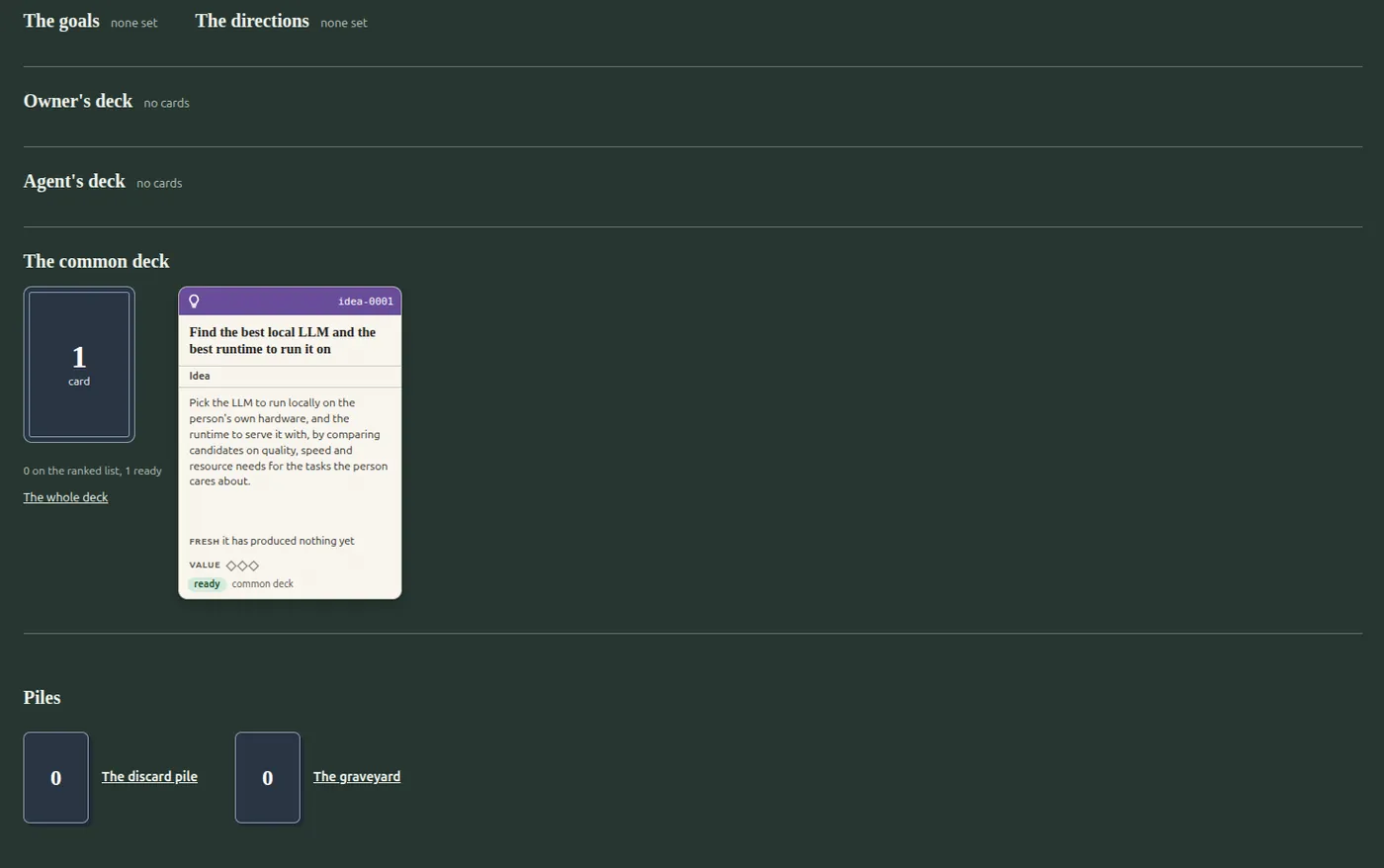
Because the setup wrote the instructions the agent reads at the start of a session, the next step begins in a new one: leave Claude Code and run claude again.
Ranking and drawing
The agent decides what to work on with one skill:
/research:whatsnextIt reviews what its hand holds, reads anything left in the inbox, ranks the open cards under the goals and directions, and draws from the top of the list into its hand until the hand is full or nothing ready is left. It works no card itself: a card is read to be ranked, and worked once it is in a hand. With one card in the project, the hand takes the idea.
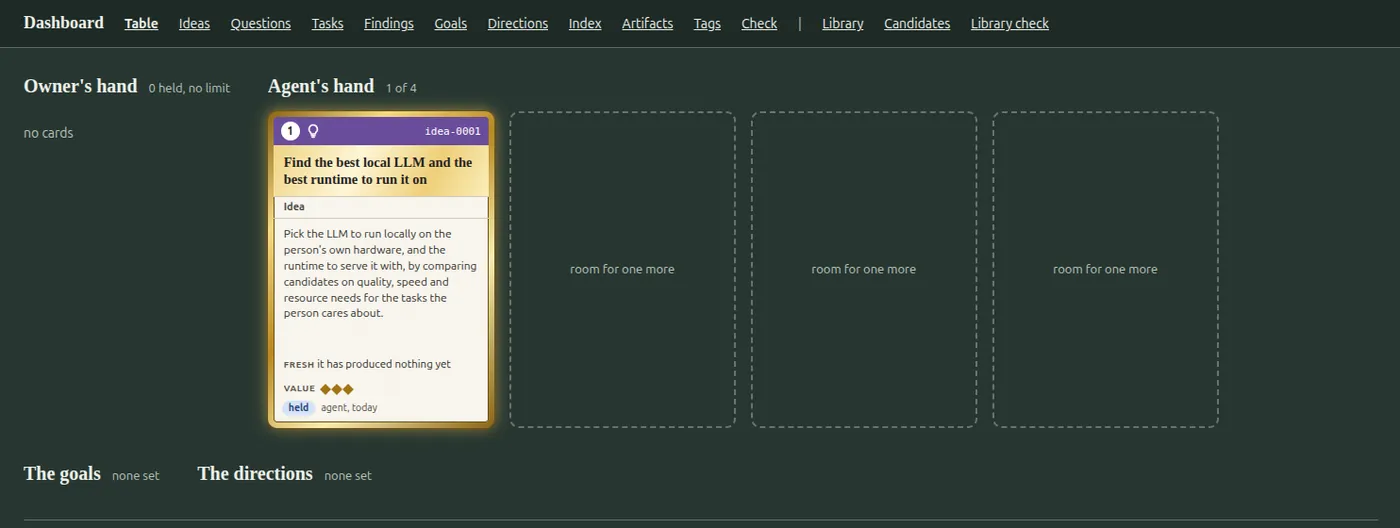
To have the agent work what it drew, say so:
Work the cards in your hand.Working an idea
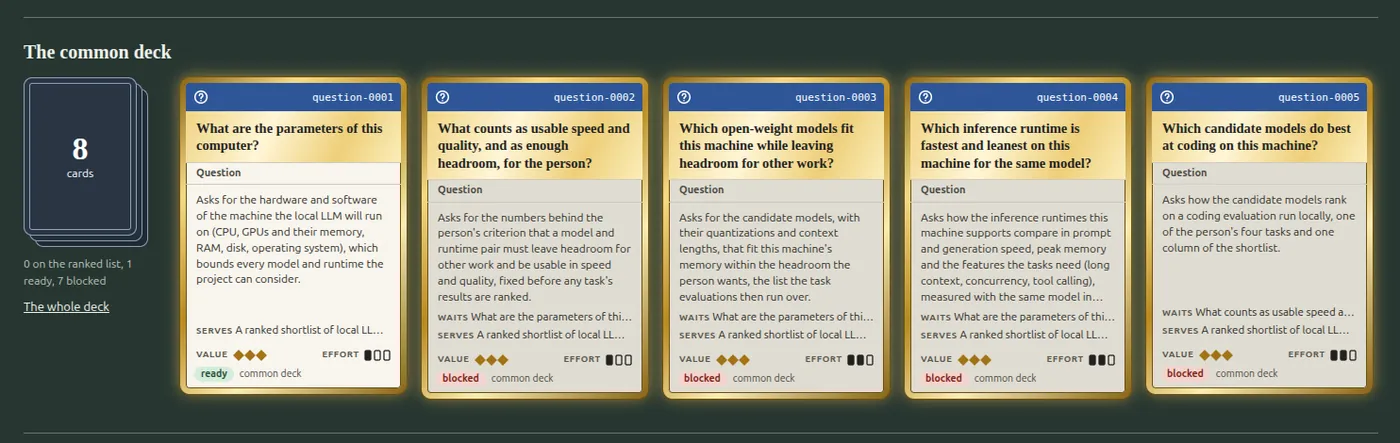
Working an idea means reading it for what it holds and minting that as cards, each naming the idea it came from. When an idea holds a destination, the agent puts it to the person before anything is minted: a goal is the person’s to commit to. Here the agent asked in one dialog whether to commit to a goal and which, which hardware, which tasks the model is for, and what wins when quality and speed pull apart. The answers chose a ranked shortlist over a single winner, this machine, and coding, chat, long documents and local agents as the tasks.
From them the agent opens a goal, a ranked shortlist of local LLM and runtime pairs measured on this machine, and the questions that serve it: the machine’s parameters, what counts as usable, which models fit, which runtime is fastest, and one question for each task. Where a question cannot move until another is answered, it is blocked on that question, so the order of the work is part of the records. Once everything in the idea lives in a card, the idea is closed as consumed.
Questions before probes
Anything the work needs to find out is a question first, minted before the act that finds it out.
The parameters of the machine are no exception: the question what are the parameters of this computer? is a card before any command reads the hardware.
The next whatsnext ranks it first, since every other question depends on it, and draws it.
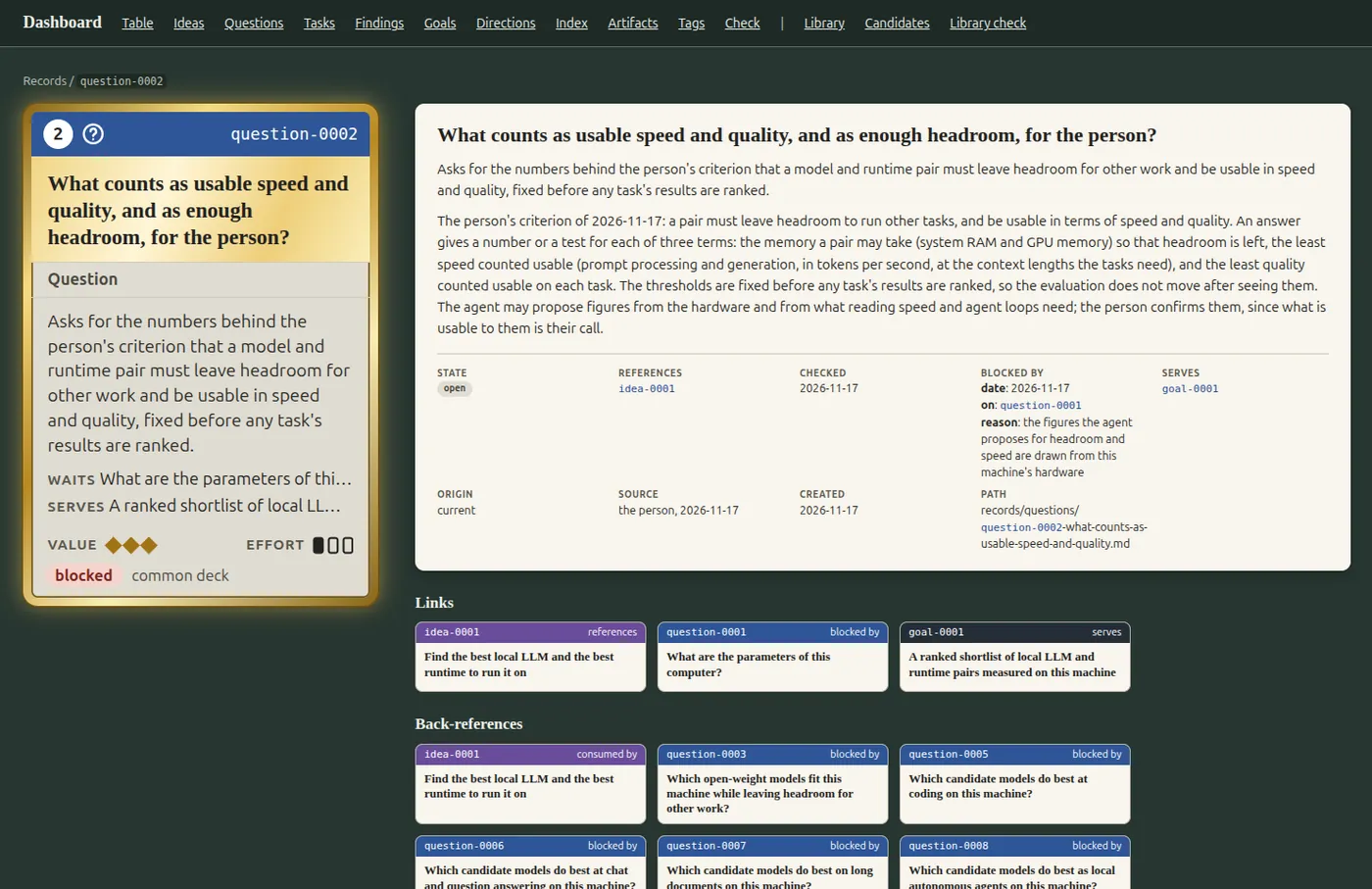
Every card has its own page on the dashboard, with the cards it links to and the cards that link to it. The question of what counts as usable, for example, is blocked on the hardware question and serves the goal:
A question is answered by a finding, and a finding names its evidence.
Here the evidence is a probe: a script committed to the project that reads the machine, writes its figures to a result file, and has a --check that reads the machine again and fails when the recorded figures no longer hold.
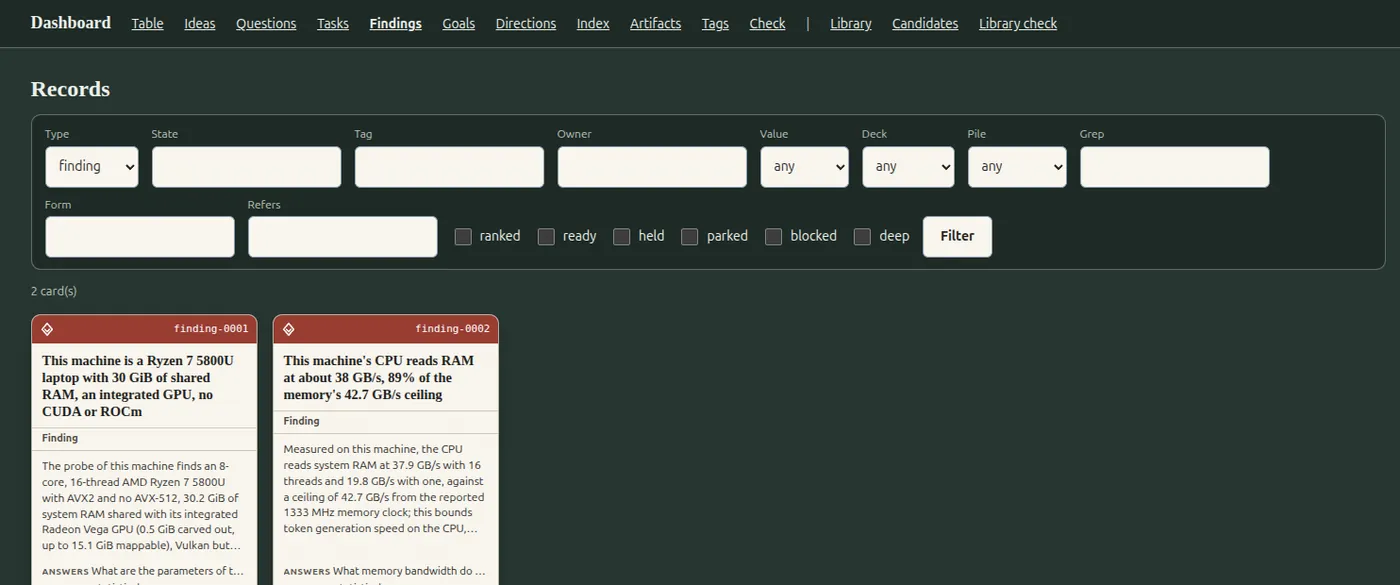
The finding records the cores, the memory and the GPU drivers the runtimes can use.
What a probe cannot settle becomes another question rather than a line in a note. The probe could not read the memory’s speed, which limits how fast a model writes text on such a machine, so the agent minted a question for it, and the next ranking drew it beside two others.
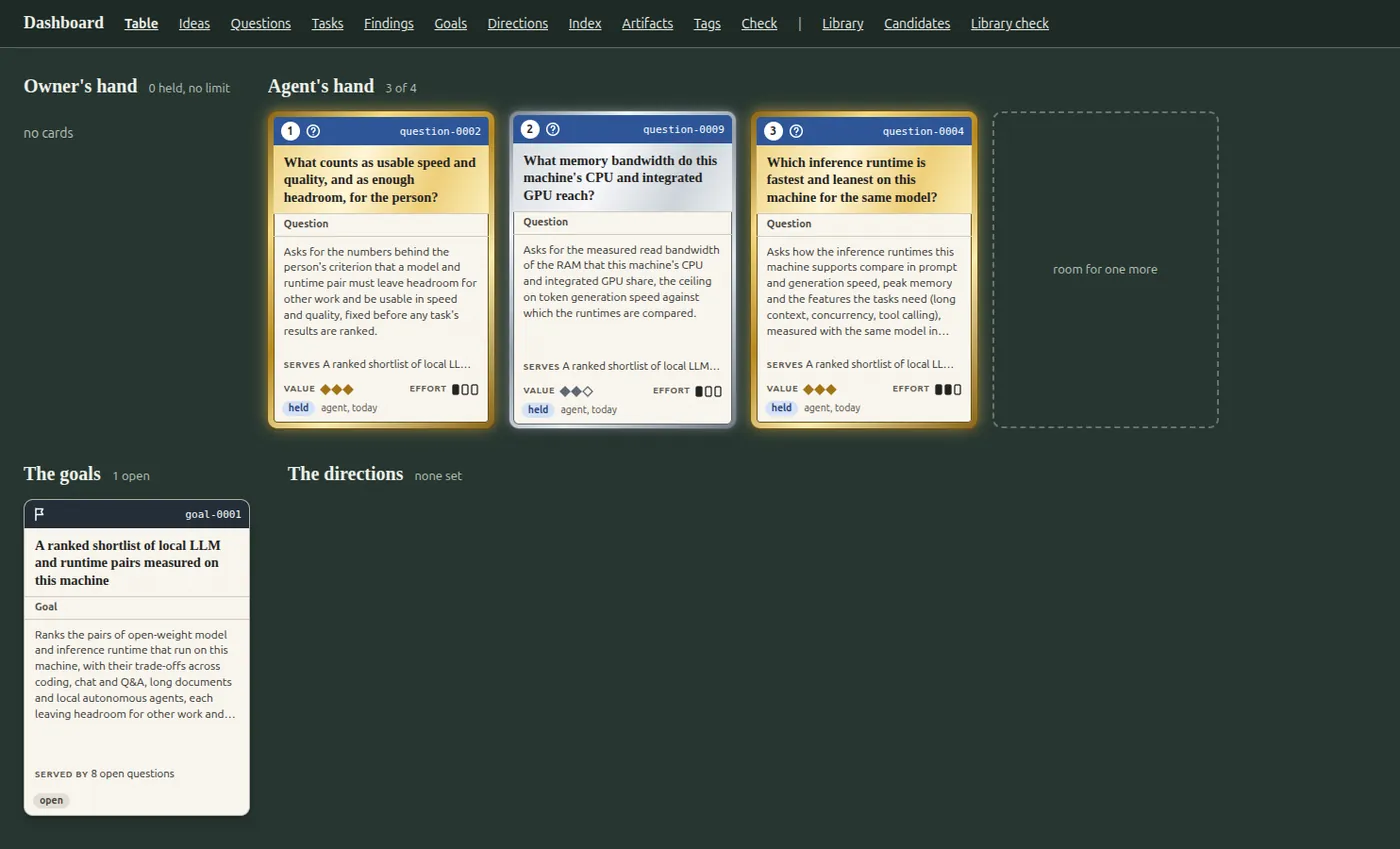
A small benchmark answered it.
Both measurements are now findings with statistical evidence: the check confirms at every commit that each script and its result file are there, and each script’s --check repeats the measurement whenever it is run.
Decisions and work that are the person’s
Before the agent asks the person anything, it asks whether a test settles the matter; what is correct is never the person’s choice. What counts as usable is not like that: no measurement says how much memory a model may take on someone’s laptop. So the agent proposes figures from the measured hardware and the person rules: here, a memory limit for a model with its runtime, a minimum speed, and no quality floor. The ruling goes into the goal’s body, dated.
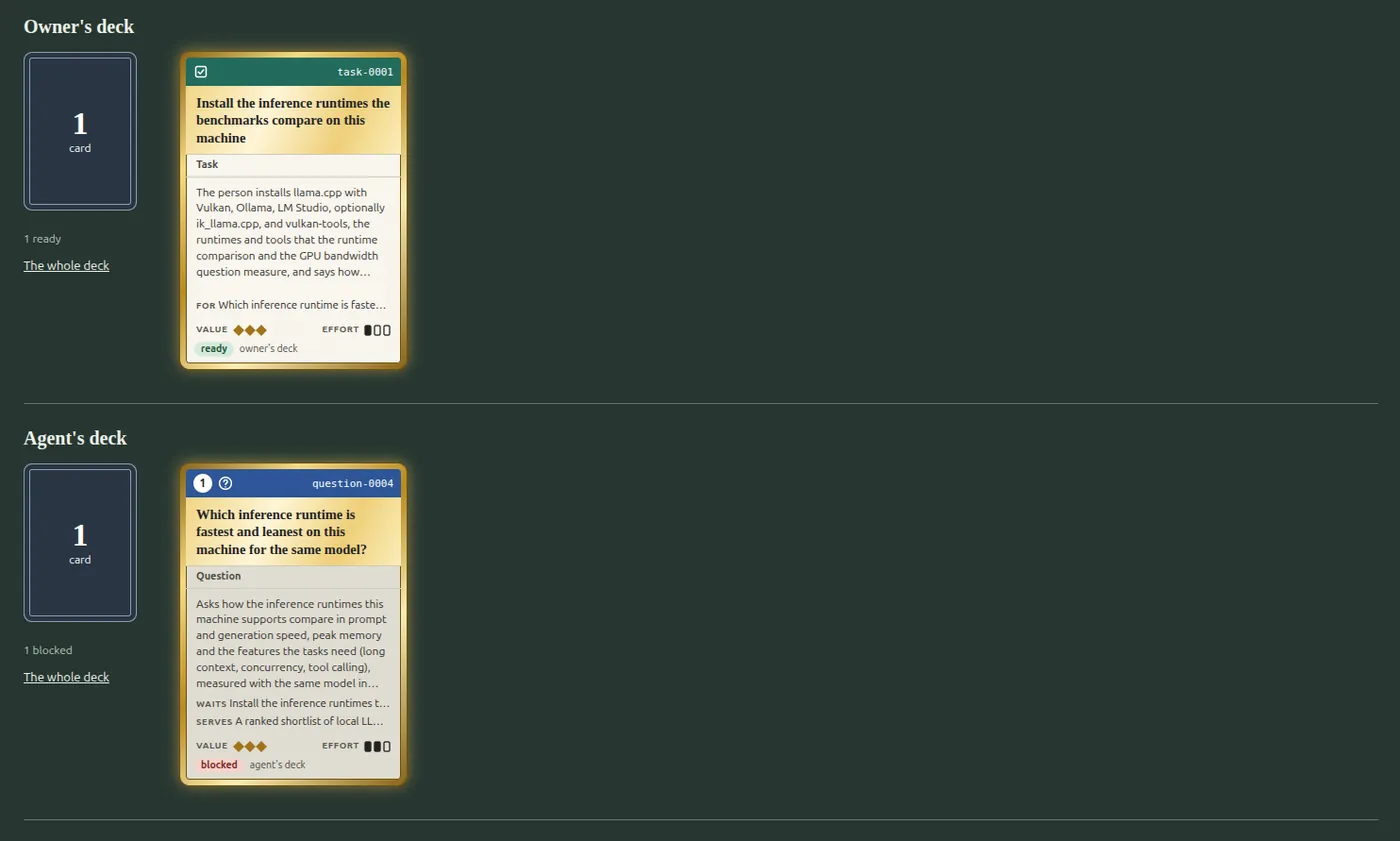
Some work is the person’s own to do. The runtimes have to be installed, and here the person chose to install them by hand, so the agent minted a task in the person’s deck listing them and blocked the runtime question on it. A card waiting on the person sits in its deck with the wait shown, and the agent’s refill passes over it.
Setting a direction
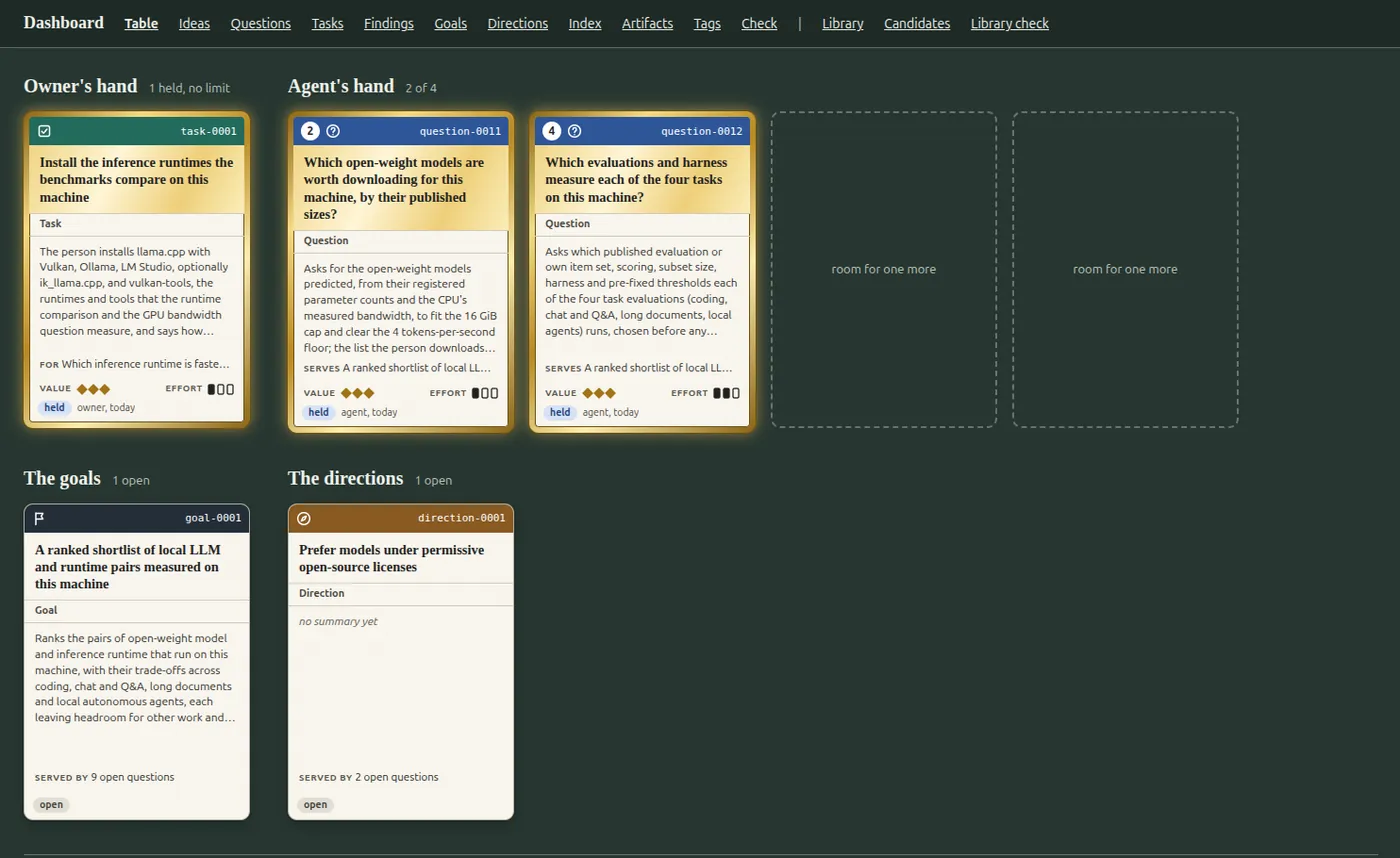
A direction is softer than a goal: it says where the person’s interest leans, and the ranking leans with it without excluding anything. Saying it in plain words is enough:
I want us to lean towards models with open licenses, such as Apache, MIT and similar ones.Before minting anything the agent asks what the words leave open: whether this is a lean or a hard rule, and which licenses count as similar. A lean, and a license the Open Source Initiative approves with no limits on use, become the direction’s body. When a case falls between the words later, as gpt-oss did with Apache 2.0 plus a usage policy, the agent asks again, and the ruling is added to the direction with its date.
Reading with the library
Papers enter the project through the library:
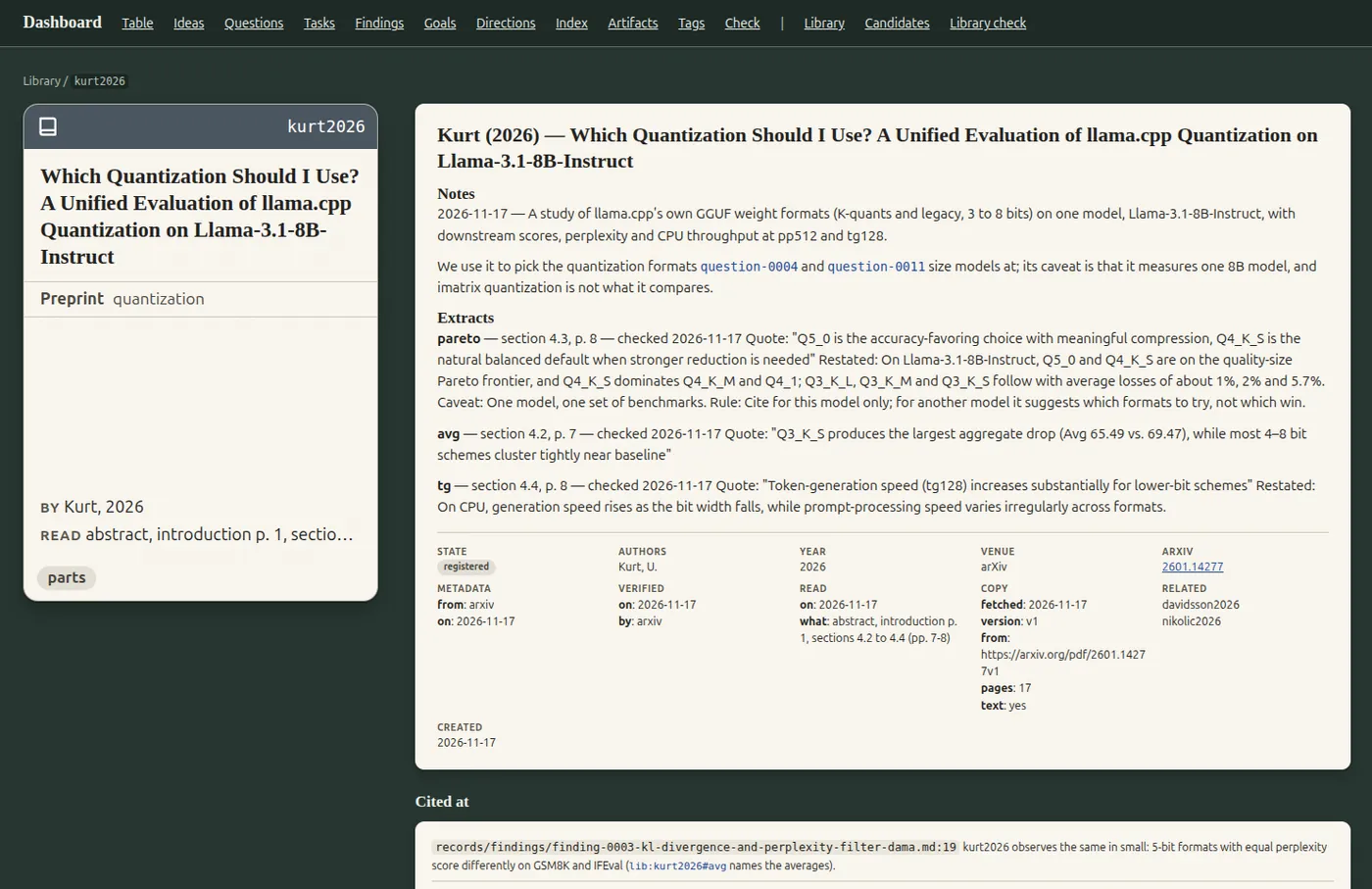
Before we move on, check recent papers on model quantization that may help us.The request becomes a question, and the agent searches, registers each work it means to use as a card, fetches the copies and reads the relevant parts itself. A summary made by another agent does not count as a read. Each card records how far the work was read, and each claim a finding rests on is an extract: a quotation with its section and page, checked against the kept copy.
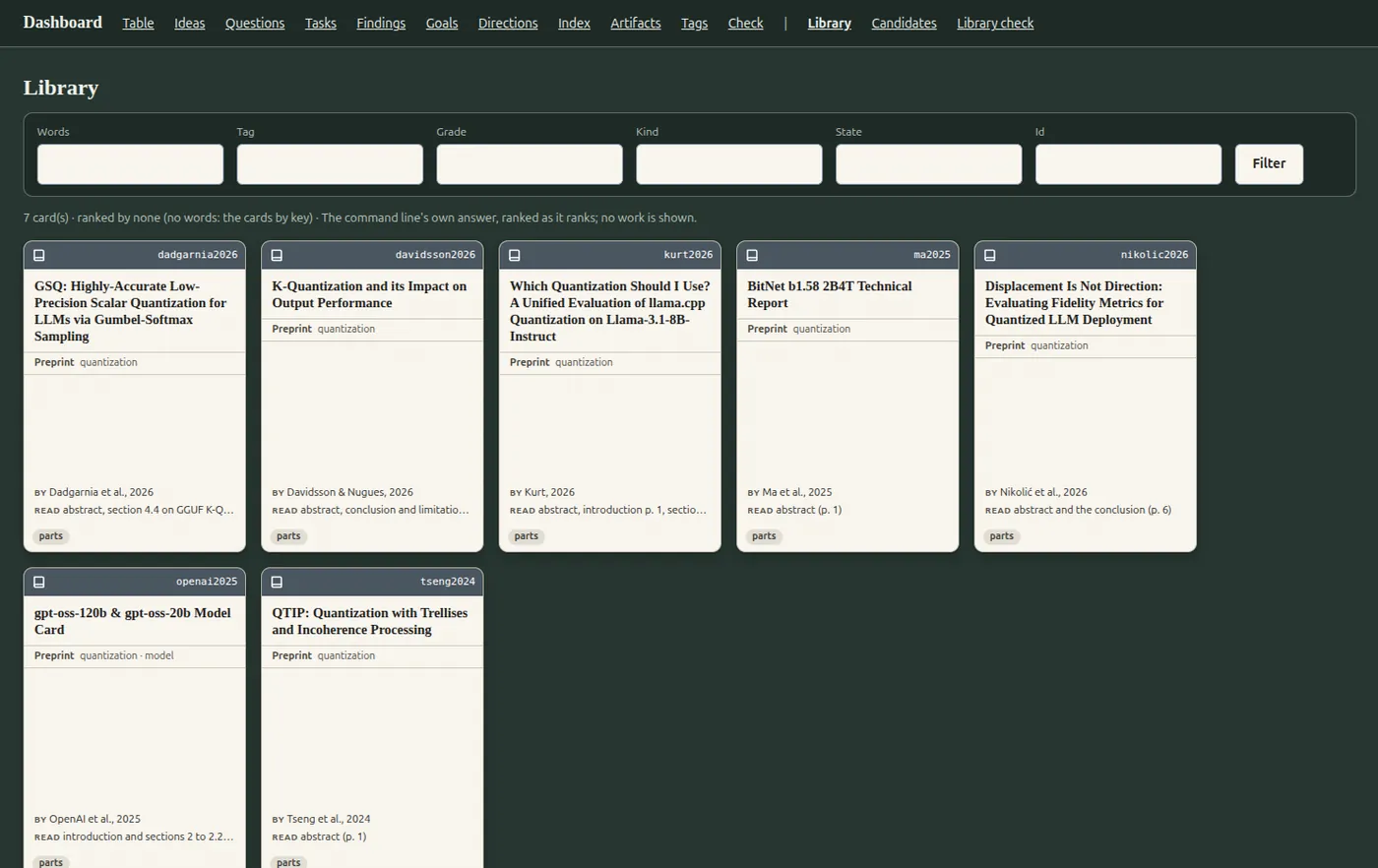
Here the reading changed the plan. One paper compares llama.cpp’s quantization formats by quality for their size (Kurt, 2026), so candidates will be sized at the formats it found best. Another finds that perplexity flags a damaged quantization but cannot rank good ones (Nikolić et al., 2026), so the evaluations will rank by task scores. What the papers left open became a question to measure on this machine.
Ending a session
A session ends with a freeze:
/research:freezeThe agent saves what the conversation found and no record holds yet, writes the log entry with a short state paragraph for the next session to trust, runs the checks and commits.
The next session starts from that state rather than from memory: /research:whatsnext reads it, ranks what is open and fills the hand again.
At the end of the example the project holds a goal, a direction, its first findings, the open questions in the order they can be worked, and a library of the works it read. It has no answer yet to which model wins, and it does not need one to be in good order: what comes next, and why, is written down and checked at every commit.
Continuing the research
Every later session repeats the same cycle: /research:whatsnext, work on the cards in hand, /research:freeze.
The person’s part is to answer the agent’s questions, do the tasks in their own deck, and add an idea or a direction whenever one comes to mind.
Questions close as findings answer them, and the goal is reached when the questions that serve it are closed.
A project is not limited to one goal. A second goal can be opened beside the first, for example a shortlist for another machine, and the ranking then weighs the open cards under both.
A reached goal does not have to end the research. When the conditions change, as when a new model or a new version of a runtime is released, an idea added to the common deck starts a fresh pass: the agent mints the questions it holds, and the earlier findings and their scripts are there to be re-run and compared. In this way a one-time study becomes one that is repeated whenever there is something new to measure.
Where to go next
Getting started shows the commands the agent runs behind each step and the files they write, and the project site documents every tool. The source is on GitHub under Apache-2.0.